
Selling into cannabis means navigating dozens of state-based markets, frequent license changes and business information that can be hard to find in one place. General market reports may show sales totals or growth forecasts, but they rarely tell an ancillary business which operators fit its offer or who to contact.
A practical research process connects the market picture to specific accounts. Here’s how to assess an opportunity, identify relevant operators and build a focused prospect list before entering a market or starting outreach.
What cannabis market research covers
Useful research has two levels. At the market level, it covers sales, growth, legalization status and license counts. At the account level, it identifies operators, locations, ownership structures and the people involved in buying decisions.
The first level, built on cannabis industry statistics, helps answer whether a market is worth attention. The second helps you work out where your product or service fits.
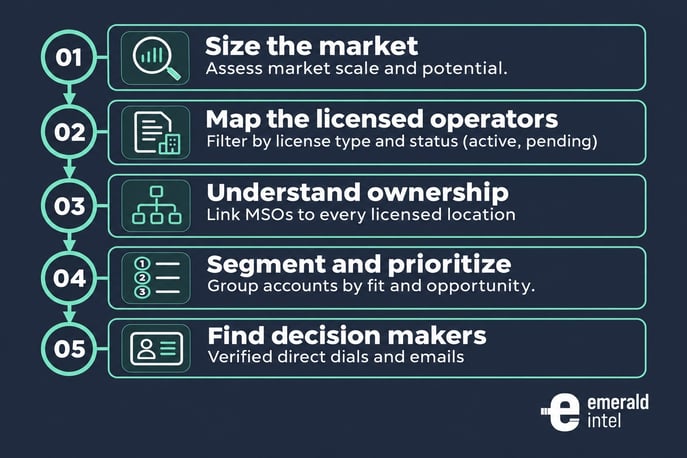
Step 1: Size the market
Start with the states or regions you’re considering. Look at sales, active licenses by type, and how those figures have changed over time. Separate medical and adult-use markets where the data allows. Their customer bases, regulations, and business models may also differ.
Market maturity matters too. A newer market may have operators preparing to launch, while an established one may offer more businesses but also more competition. Neither is automatically the better opportunity. Consider the size of the market alongside your product, its likely buyers, and the time it could take to sell there.
Cannabis analytics can help compare markets, but only when you understand what the underlying figures include. License totals can mean different things depending on whether they count pending, inactive or expired licenses. Check the definitions before drawing conclusions.
Step 2: Map the licensed operators
Next, identify which license types are relevant to what you sell. A company supplying cultivation equipment will be interested in different businesses from one selling retail analytics, packaging or compliance software.
Then look at license status. Active licenses can help you identify operating businesses. Pending licenses may point to companies preparing to enter the market, but they don’t prove that a business is open or ready to buy. Treat them as a research lead and verify the company’s status before adding it to an outreach list.
A license record is a starting point. Company names, locations and operating status help make it useful.
Step 3: Understand ownership and structure
A license isn’t always a separate business. One parent company may control multiple licenses, brands or locations, while an independent operator may hold a single license.
Understanding those relationships changes how you prioritize accounts. If one company operates across several locations, a successful sale could lead to a wider rollout. If its locations are independently managed, you may need to approach each business separately.
Look for parent companies, subsidiaries, brands and location relationships. Where ownership is unclear, record that uncertainty rather than treating every license as a separate prospect.
Step 4: Segment and prioritize accounts
Once you have a list of operators, group them by the characteristics that matter to your offer. These might include license type, location, number of sites, business size or stage of operation.
You can also consider technographics: the software or systems a business uses. That information can help you identify a stronger fit for a technology product, although it may not be available or current for every operator.
The aim is to move from a long list to a manageable set of accounts with a clear reason for being there. You might prioritize operators with multiple locations, businesses in a particular stage of growth or companies that match your existing customer profile. Record the reason for each priority so sales and marketing can act on the same information.
This is where cannabis data analytics can help turn market and license records into a more useful target account plan.
Step 5: Find the decision makers
The right contact depends on what you sell and how the buying decision is made. Cultivation inputs may interest a cultivation director or head grower. Software could involve operations, compliance, finance or IT. A product used across a business may require several people to assess it.
Search for relevant roles at the account level, then verify that the person still works there and has a connection to the need you’re addressing. A current business email or direct number is usually more useful than a generic “info@” inbox, but contact details should be treated as data to verify, not assumed to be correct.
Click here for more on using cannabis data to build a sales prospecting process.
What to look for in a cannabis market research data source
For teams evaluating cannabis data companies, the same checks apply to any source you consider. Find out how often its information is updated and how it is verified. Check whether it covers only licenses or also includes companies, locations, ownership, and contacts. Look for clear data definitions and confirm that you can access the details your team needs.
It’s also useful to consider how the data fits your workflow. Can you export it or connect it to the tools your sales team already uses? Which integrations are available?
Build a clearer picture before you enter
Cannabis market research works best as a series of connected decisions: size the opportunity, identify relevant licenses and operators, understand how those businesses are structured, prioritize accounts, and find the right people to contact.
Emerald Intel provides cannabis market intelligence for B2B teams researching markets and operators. Request a demo to see how it could help your team build a more focused prospect list.