
Michigan is the third state we evaluated to understand how municipal bans affect state markets. As of early 2024, roughly 74% of the state's 1,856 cities, villages, and townships — about 1,371 communities — had passed ordinances prohibiting cannabis establishments, the highest municipal refusal rate of any state we've examined, comfortably above New York's 57% and more than double Massachusetts's 30%. Today, according to Emerald Intel's July 2026 store-level data, 831 open cannabis storefronts operate across 227 municipalities — meaning 88% of Michigan municipalities have no open cannabis store at all, a figure that includes both prohibition towns and communities that have permitted cannabis but not yet attracted an operator.
And yet Michigan is, by nearly any measure, one of the strongest adult-use markets in the country — routinely cited as the national leader in per-capita cannabis sales, with Detroit alone hosting more than 50 open storefronts. Understanding how both of those things are true at once is the whole point of this piece.
A Statute That Reversed Course
On paper, Michigan's 2018 law (MRTMA, passed by voters as Proposal 1) is written the same way as New York's and Massachusetts's: cannabis establishments are permitted by default, and a municipality that wants to block them must affirmatively act. Section 6 of the act says a municipality "may completely prohibit or limit the number of marihuana establishments within its boundaries." Opt-out, not opt-in.
Michigan municipalities moved fast — in the wrong direction. Between the November 2018 vote and the launch of state licensing in November 2019, the overwhelming majority of Michigan's roughly 1,800 municipalities passed prohibition ordinances. Most framed them as placeholders while they waited to see how the state would regulate the market. But the effect was decisive: by the time the first licenses were available, most of the state had already said no. A community that now wants cannabis businesses has to repeal or replace an ordinance it already passed. As the Citizens Research Council of Michigan put it, the opt-out requirement "effectively operates as an opt-in provision today." The law said opt-out; local behavior produced opt-in.
That distinction matters for anyone tracking newer legal states. New York's opt-out deadline forced a one-time decision; Massachusetts towns settled into positions over eight years. Michigan's picture keeps changing — municipalities have been voting to allow cannabis businesses every year since 2019, and the number of communities with active storefronts has risen steadily. The opt-out rate is declining; it is not fixed.
Who Actually Lives in Opted-Out Michigan
Michigan has more local governments than almost any other state — over 1,850 cities, villages, and townships, most of them small. With three-quarters of those having opted out, you'd expect a large share of Michigan residents to be cut off from legal cannabis. They're not. Here's why.
The key fact: the overwhelming majority of Michigan's largest cities have opted in. Detroit (638,000 residents), Grand Rapids (199,000), Warren (139,000), Lansing (113,000), Westland (85,000), Flint (81,000), Southfield (76,000), Kalamazoo (73,000), Waterford Charter Township (70,000), and Taylor (63,000) all appear on the CRA's active license list. Every Michigan city with a 2020 population above 50,000 that we can identify in the CRA data has opted in.
We matched the CRA's opt-in list against 2020 Census population figures for Michigan. The 137 municipalities with documented adult-use license terms are home to roughly 2.67 million people — about 26.5% of the state's 10 million residents. The full opted-in universe of roughly 485 municipalities would push that share to around 31%. Either way, the population share and the municipal share land in nearly the same place: about a quarter of communities, about a quarter of people.
That last point cuts against a simple story. Michigan's opted-out towns are overwhelmingly small — the median Michigan township has a 2020 population of 1,895, and 52% of townships have fewer than 2,000 residents — but many of its opted-in towns are small too. The opted-out majority isn't mostly empty geography surrounding a few big opted-in cities. It's a genuine mix of small communities on both sides of the line. What tips the market in favor of access is that every major city has opted in, not that the opted-out communities are negligible in size.
Geography: Highways, Colleges, and Revenue Checks
Where opted-in communities cluster tells you more about economic incentives than about regional politics. College towns were among the earliest to opt in. Small cities near highway interchanges opted in to attract pass-through business — sometimes while every surrounding township stayed out, creating what we'd call the Michigan border-town effect: a single permitted community serving a large area with no local storefronts. Licensed retail density is highest along the I-94 corridor from Detroit through Ann Arbor to Kalamazoo, around Grand Rapids, and in the Traverse City area. Northern Lower Michigan and the Upper Peninsula are thinly served, but that reflects sparse population as much as local politics — the UP's roughly 300,000 total residents are fewer than Grand Rapids alone.
The border-town effect is most visible at its extreme. New Buffalo Township — population roughly 1,100, tucked into Michigan's southwest corner on the Indiana border — has 38 open cannabis storefronts as of July 2026, making it the second-largest cannabis market in the state by store count, ahead of Grand Rapids, Lansing, and Ann Arbor. It exists almost entirely to serve cross-border traffic from the Chicago metro, where Illinois taxes are higher and selection thinner. One small township that made a single zoning decision is outperforming major cities. That is the border-town thesis in its purest form.
The affluent-suburb resistance pattern we documented in metro Boston and downstate New York has a Michigan version: several Oakland County communities have opted in for retail only, with tight license caps, while neighbors have stayed out. But that's one thread in a varied picture, not the organizing principle the way it is in Greater Boston.
The strongest pull toward opting in has been financial. Michigan distributes 15% of adult-use excise revenue to municipalities that host licensed retailers, and 15% to counties. In fiscal year 2025, that meant tens of millions of dollars flowing to opted-in communities. Each year's distribution announcement triggers a fresh round of township boards asking whether they want to keep leaving that money on the table. The answer, more often than not, has been no — and the opted-in count rises accordingly.
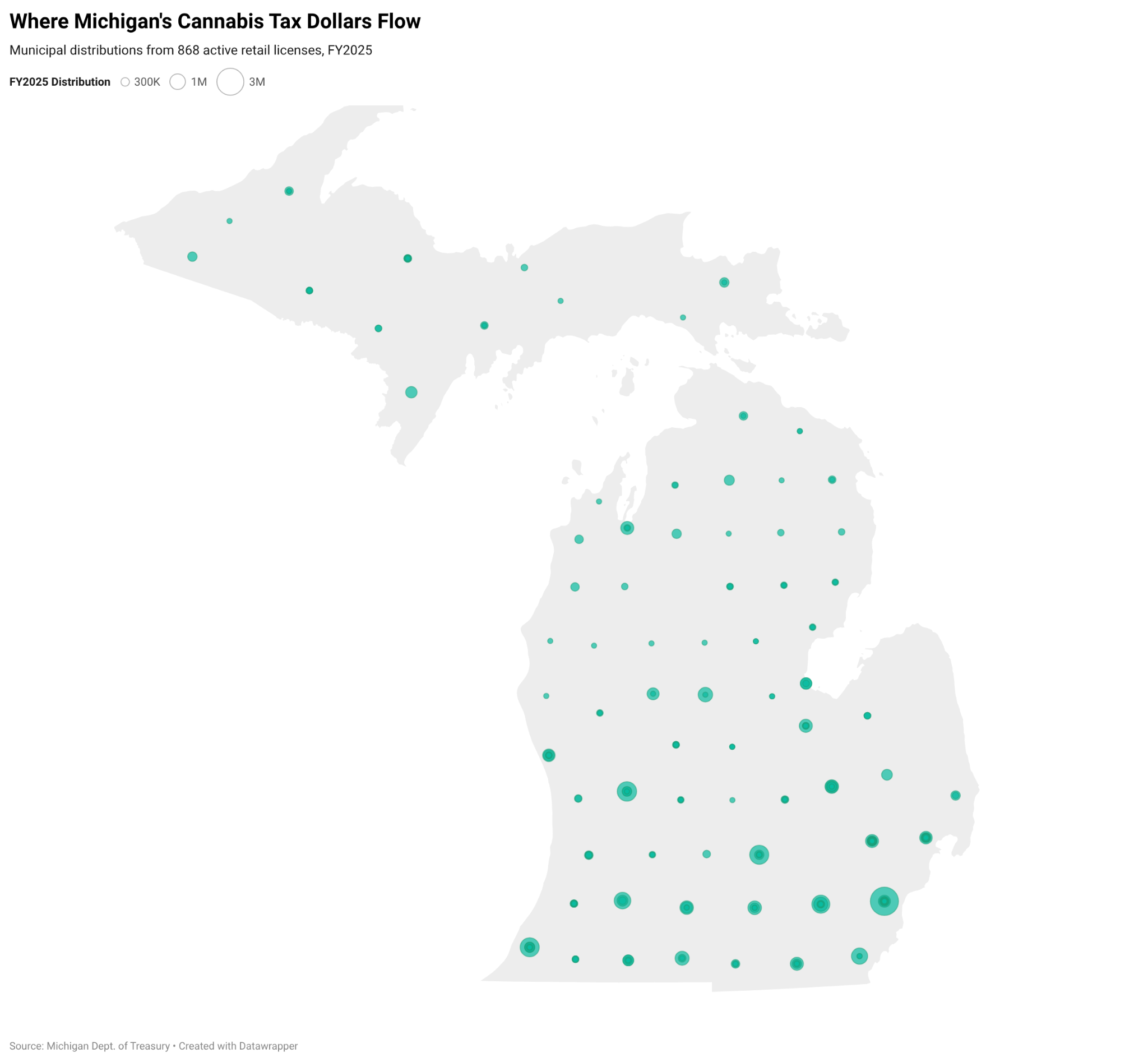
Where the money goes: FY2025 municipal distributions from Michigan's adult-use cannabis excise tax, sized by total distribution received. Only 234 of Michigan's 1,856 municipalities received a check — all others had no active licensed retailer as of September 30, 2025. Source: Michigan Department of Treasury.
Delivery: Why the Opted-Out Majority Still Matters to Operators
In Michigan, the fact that three-quarters of municipalities have opted out doesn't mean three-quarters of residents are locked out of the market. That's because Michigan law prohibits municipalities from blocking cannabis deliveries, regardless of their opt-out status. The CRA's FAQ is direct: a municipality may not adopt an ordinance that restricts the transportation of marijuana through the municipality. Opted-out towns can exclude every storefront, grower, and processor — but they cannot stop a licensed retailer's vehicle from delivering to a resident's door.
This is why Michigan's delivery rule is the most consequential of any state we've analyzed. A dispensary in Detroit or Grand Rapids can legally reach customers across a wide ring of surrounding townships that have no storefront of their own. Exclude those townships from your demand model and you're leaving a substantial portion of the market off the spreadsheet — an error that compounds across hundreds of small communities.
To see how unusual this is, place the four states side by side. Michigan: statewide delivery, no municipal override, by statute. California: same result, but only after 24 cities sued and lost, codified by SB 1186 (2022). New York: no ban mechanism exists, delivery permitted statewide. Massachusetts: a narrow, Commission-approved, time-limited waiver — the only state to build a local delivery ban, and it built a small one. Michigan arrived at the most permissive position earliest, and did so without litigation.
What Michigan's Numbers Actually Mean
First, a high opt-out rate doesn't mean a hostile market. "74% opted out" sounds like a nearly closed state. The market data says otherwise. The opted-in 26% includes virtually every major commercial center in Michigan, and delivery reaches the rest. Raw jurisdiction counts are a poor proxy for market access.
Second, the text of the law matters less than when municipalities had to decide. Michigan wrote an opt-out statute and got a de facto opt-in system, because local governments acted before the market existed and before the financial consequences were visible. New York and Massachusetts wrote similar statutes and got different outcomes because the timing was different. Anyone projecting municipal opt-out rates in newly legal states should pay as much attention to the decision timeline as to the statutory language.
Third, revenue sharing is the most effective tool states have for expanding access over time. No state we've studied has a more direct financial incentive for municipal participation, and no state has seen a steadier drift toward more opt-ins year over year. New York, where opted-out municipalities forgo local revenue, has seen a much slower shift. The mechanism matters.
The market modeling lesson is the same one we drew from New York and Massachusetts, with a Michigan-specific addition: model at the municipality level, not the state level. In Michigan, weight by population and drive-time access rather than raw jurisdiction counts. And treat the current opted-in list as a floor that rises each year. The best leading indicator of where that pressure is building is the state treasury's annual distribution report — which lists every municipality that received a check for hosting a licensed retail store or microbusiness. Cultivation and processing don't qualify. A township watching a neighboring community collect $54,000 per storefront per year tends to reconsider its retail ban before the next board election.
Data sources
-
Active storefront count: Emerald Intel store-level database, pulled July 24, 2026; 831 open cannabis storefronts across 227 municipalities; store count used rather than license count to avoid double-counting locations holding both medical and adult-use licenses
-
Municipal opt-out rate (74%): Michigan Cannabis Regulatory Agency, monthly municipal report (Feb. 2024), as compiled by Cannabis Business Times; reflects ordinance status, not active licensee presence; confirm current figures at michigan.gov/cra
-
Opt-in license terms: CRA, MRTMA Municipal Opt-In list (publicly posted), michigan.gov/cra
-
Population: U.S. Census Bureau, 2020 sub-county population estimates, vintage 2025 release; Emerald Intel join of CRA opt-in list to Census data (135 of 137 municipalities matched)
-
Statutory basis: MRTMA Section 6, Initiated Law 1 of 2018; "effectively opt-in" characterization per Citizens Research Council of Michigan
-
Delivery rule: CRA FAQ, michigan.gov/cra/faq
-
Revenue distributions: Michigan Dept. of Treasury, Adult-Use Marijuana Distributions, FY2025 (Feb. 2026); 234 municipalities, 868 retail and microbusiness licenses, $93.8M total distributed; retail and microbusiness only per MRTMA Section 14 (MCL 333.27964); michigan.gov/treasury/local/share/marijuana/adult-use
-
NY and MA comparisons: Emerald Intel Market Pulse, June–July 2026
-
Municipal ordinances change frequently; confirm status with individual municipalities before making licensing or investment decisions.