
The Massachusetts Cannabis Control Commission published something new in July 2026: 13 municipalities have obtained waivers allowing them to prohibit adult-use cannabis deliveries to their residents.
Thirteen is a small number. But the waivers represent something unusual in state cannabis policy. Massachusetts now allows qualifying municipalities not only to prohibit cannabis retailers within their borders, but also to prevent licensed operators located elsewhere from delivering cannabis to local consumers.
Most states do not give municipalities comparable authority. Some expressly prevent local governments from interfering with licensed cannabis delivery or transportation. Massachusetts has instead created a narrow waiver process that separates two questions often treated as one: whether a community will host a cannabis retailer and whether its residents will have access to the regulated market.
What the Opt-Out Map Shows
Massachusetts voters approved adult-use cannabis legalization in 2016, with legal possession and use beginning that December and retail sales starting in November 2018. Nearly eight years into the commercial market, the Commonwealth’s 351 cities and towns have settled into a range of local positions.
The Cannabis Control Commission’s Municipal Zoning Tracker is more nuanced than New York’s opted-in/opted-out framework. It distinguishes among municipalities that allow adult-use retail, prohibit all marijuana establishments, prohibit retailers specifically, or have no clearly reported zoning position.
- 56% (197 municipalities) have zoning allowing adult-use retail, although some impose license caps or other restrictions.
- 30% (106 municipalities) prohibit all marijuana establishments.
- 3% (12 municipalities) have cannabis zoning but specifically prohibit adult-use retailers.
- 10% (36 municipalities) have no clearly reported position: 25 did not respond to the Commission’s survey and 11 are listed as having no cannabis zoning.
These categories apply to adult-use establishments. Medical marijuana is governed separately, and medical delivery remains permitted in all 351 municipalities.
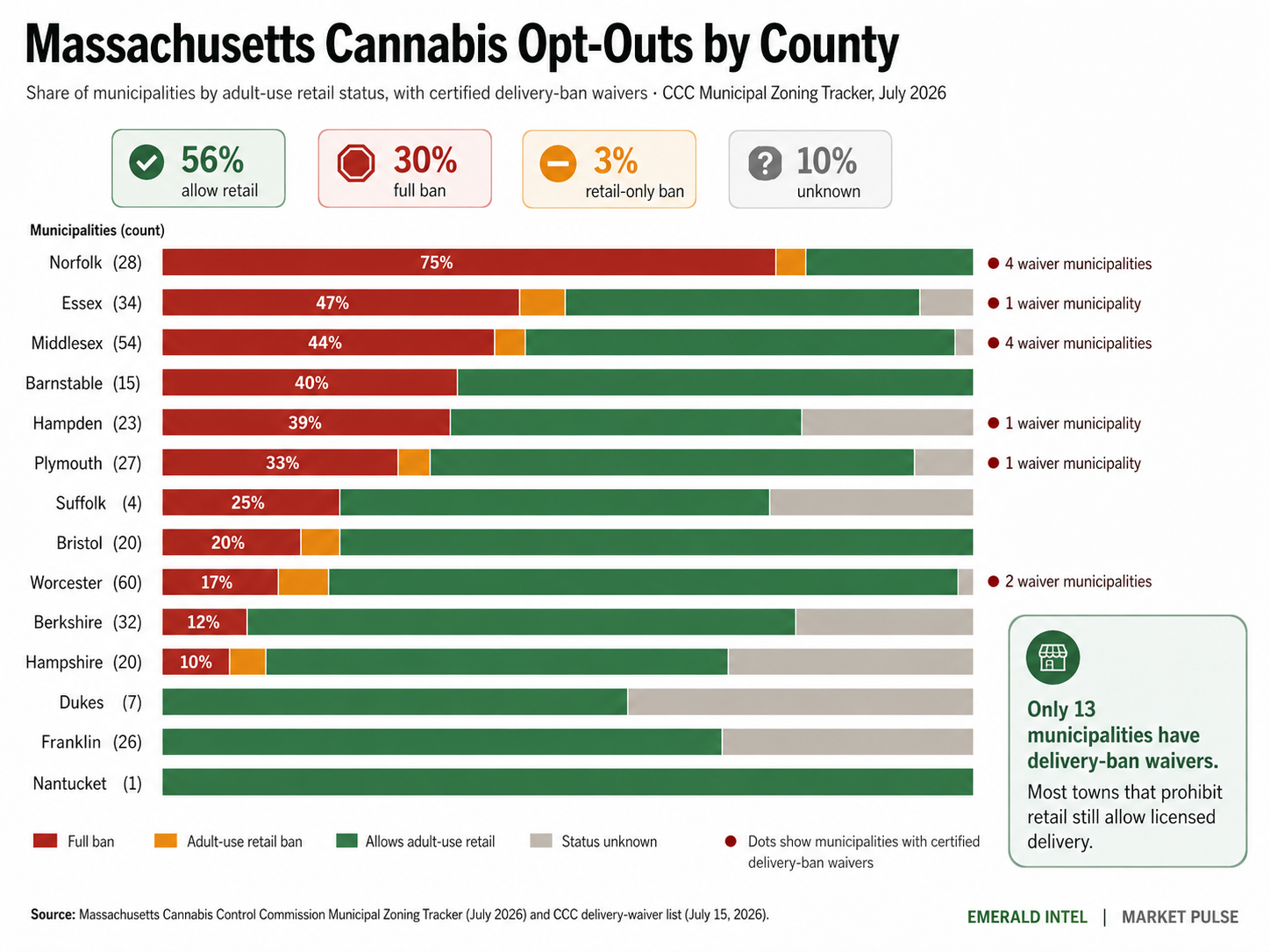
Massachusetts municipal cannabis policy varies substantially by county; certified delivery-waiver municipalities are concentrated in a small number of counties.
Massachusetts’s 30% full-ban rate is considerably below what we found in New York, where 57% of municipalities had opted out of adult-use dispensaries, on-site consumption establishments, or both. The comparison is not exact because the two states classify municipal policies differently. But it reinforces a broader point: statewide opt-out averages are of limited value for market sizing. Local access must be evaluated state by state—and often municipality by municipality.
The population results largely mirror the municipal count. Massachusetts municipalities with comprehensive bans account for approximately 29.5% of the state’s population, close to their 30% share of municipalities. That suggests comprehensive bans are not concentrated exclusively among either the Commonwealth’s largest cities or its smallest towns.
The 36 municipalities without a clearly reported position also show a geographic pattern. Many are in Berkshire, Franklin, and Hampshire counties, leaving operators evaluating western Massachusetts with a less complete picture than they would have in Greater Boston.
The New Policy Layer: Delivery Waivers
Chapter 65 of the Acts of 2026 established adult-use delivery as the statewide default. But it also created an exception: a municipality that does not authorize marijuana retailers may request a waiver from the Cannabis Control Commission and prohibit adult-use delivery to local residents.
The waiver is limited in several ways. It requires Commission approval, lasts no more than two years and may be renewed only at the Commission’s discretion. The law therefore stops well short of giving every municipality unrestricted authority over cannabis delivery.
As of July 15, the Commission had certified waivers for 13 municipalities. Two selected one-year prohibitions rather than the two-year maximum. Medical marijuana delivery remains permitted statewide.
The 13 municipalities are concentrated in the Boston suburban belt. Eight are in Middlesex or Norfolk counties: Hopkinton, Lexington, Lincoln, Wayland, Avon, Foxborough, Medfield and Needham. Middleton lies immediately north in Essex County. Holden and Westborough are in Worcester County, Hampden is outside Springfield, and Mattapoisett is on the South Coast.
Most Retail-Ban Communities Still Allow Delivery
The most important finding is not simply that 13 municipalities obtained waivers. It is that most municipalities without adult-use retailers have not done so.
The zoning tracker identifies 106 municipalities with comprehensive establishment bans and another 12 with retail-specific bans. Among that broader group of 118 municipalities without authorized adult-use retail, only 13 had obtained delivery waivers as of July 15. In other words, most Massachusetts municipalities that prohibit cannabis storefronts continue to allow delivery from licensed operators located elsewhere.
Massachusetts has effectively created three local policy positions:
- Allow retailers and delivery.
- Prohibit retailers but allow delivery.
- Prohibit both retailers and delivery.
The second position appears to be the most common among municipalities that do not host retail businesses. That distinction is meaningful. Opposition to a dispensary does not necessarily mean opposition to legal cannabis access. A municipality may object to storefront traffic, signage, parking, land use or neighborhood impacts without seeking to prevent adults from ordering regulated products for delivery.
Why Massachusetts Is Different
Other states generally place tighter limits on municipal interference with delivery and transportation. California prevents local governments from blocking licensed cannabis transportation on public roads and restricts local authority over delivery even where storefront dispensaries are banned. Michigan similarly states that delivery may occur in opted-out municipalities and that municipalities may not restrict marijuana transportation through their borders.
New York’s municipal opt-out applies to adult-use dispensaries and on-site consumption establishments. It does not provide a comparable process through which municipalities can prohibit delivery to local residents.
Massachusetts has taken a narrower approach than simply allowing municipalities to stop cannabis vehicles at their borders. The waiver applies to delivery to recipients within a municipality, is available only where retailers are not authorized, requires Commission approval and expires after no more than two years unless renewed.
The structure preserves statewide control over licensed transportation while allowing a limited local restriction on the completion of deliveries. Whether it will eventually face a legal challenge remains unknown, but it is materially different from the broad municipal delivery bans contested or preempted elsewhere.
Where Massachusetts Lands
Massachusetts is more permissive than New York toward physical cannabis businesses: 30% of its municipalities prohibit all marijuana establishments, compared with the 57% of New York municipalities that opted out of dispensaries, on-site consumption or both.
At the same time, Massachusetts has created a form of municipal authority that New York does not provide and that states such as California and Michigan generally preempt: a formal mechanism allowing qualifying communities to prohibit adult-use delivery.
That makes Massachusetts simultaneously more permissive in one respect and potentially more restrictive in another. For operators, the practical lesson is straightforward: statewide legality does not define the addressable market, and neither does a single statewide ban rate. Market access must be assessed at the municipal level and by channel.
A town may prohibit dispensaries but permit delivery. Another may allow cultivation while prohibiting retail. A third may exclude both storefronts and deliveries. Massachusetts has made those distinctions unusually visible—and increasingly consequential.
Sources and methodology
Massachusetts legalization: Massachusetts state statement on legalization taking effect in December 2016
Delivery-waiver law: Chapter 65 of the Acts of 2026
Waiver certifications: Massachusetts Cannabis Control Commission announcement, July 15, 2026
Municipal zoning data: Massachusetts Cannabis Control Commission Municipal Zoning Tracker
The Municipal Zoning Tracker is a general reference resource rather than a definitive legal determination of local law. Municipal bylaws and policies may change, and individual municipal status should be independently confirmed.